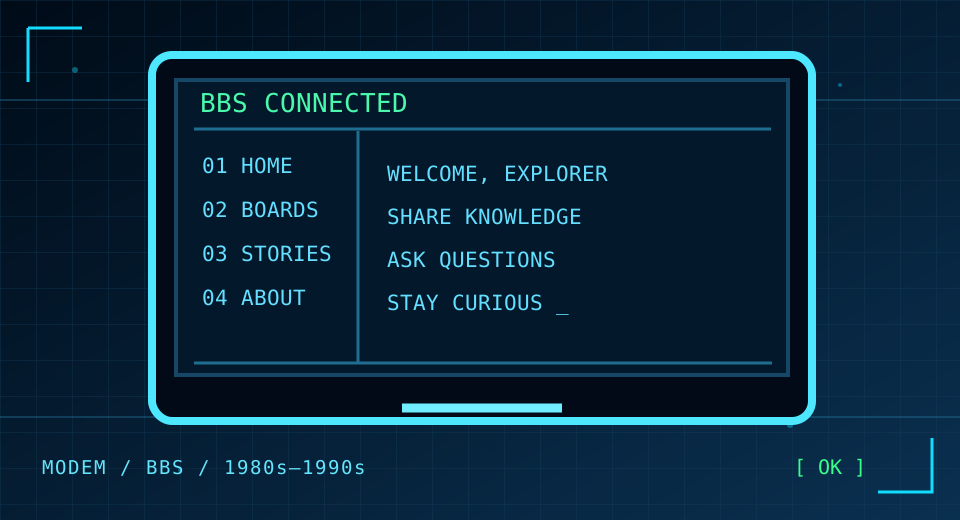
Before browsers and feeds, people dialed a phone number, heard a modem negotiate a connection, and entered a text-driven world. Bulletin board systems — BBSes — were miniature communities built from messages, files, handles and patience.
One call at a time
A typical bulletin board was hosted on a computer connected to a telephone line. A caller used a modem and terminal software to reach it. Depending on the system, that meant reading posts, joining discussions, exploring file libraries or sending private messages.
Some small boards supported one caller at a time. Larger systems added additional lines and nodes. Local culture mattered: the sysop, or system operator, often set the tone of the community and maintained the machine.
An interface made from characters
ASCII and ANSI art turned text terminals into expressive visual spaces. Box-drawing characters, color codes, glowing text and elaborate menu screens made a strong impression even when bandwidth was scarce. That visual discipline still offers lessons: hierarchy, fast loading, direct interaction and meaningful feedback.
Independent networks, independent ideas
Boards nurtured many interests, from programming and science fiction to gaming, hardware and computer security. Some communities connected through store-and-forward networks such as FidoNet. Other spaces were exclusive or controversial. There was no single BBS culture, but many overlapping scenes.
The retro-web experiment
White2Hack borrows the old interface language without requiring a modem, a user account or a special client. Arrow navigation, highlighted selections and terminal-looking panels are simply a playful way to browse ordinary HTML content. All the important links are regular links.
BBS nostalgia is best when it inspires independent publishing, craftsmanship and community — not when it makes a modern website harder to use.