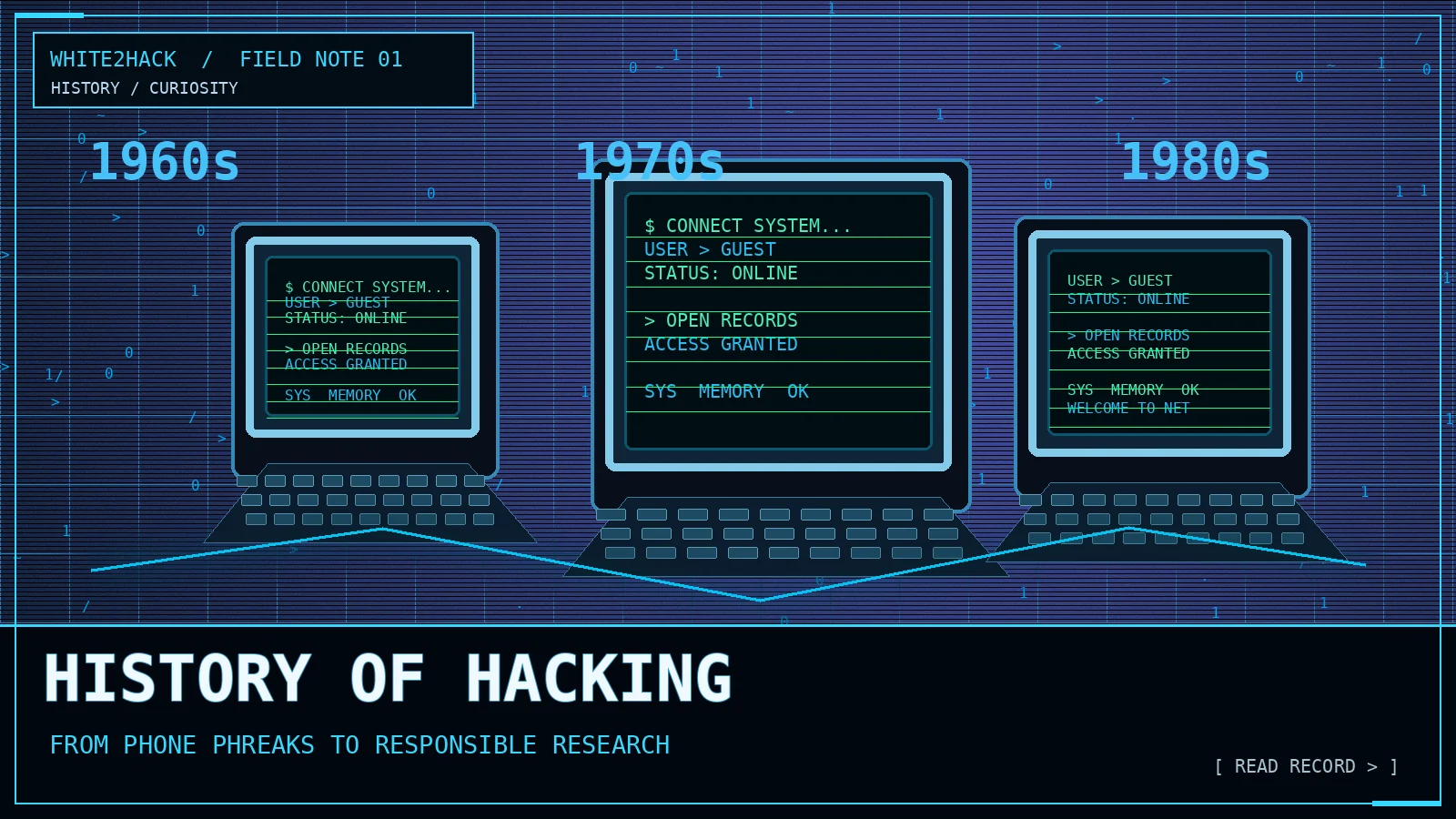
Before security became a professional discipline, a loose network of curious people was already studying how phones, computers and communications systems behaved. Their motivations and methods varied. The impulse to understand a system deeply still runs through responsible security research today.
Curiosity came first
The word “hacker” has never meant only one thing. In early computing circles it often described someone who approached a technical problem with ingenuity and persistence. Clubs, university labs and hobbyist communities exchanged ideas, experiments and practical knowledge.
Some of that experimentation was constructive; some crossed legal or ethical boundaries. That distinction matters. A clever result is not automatically an authorized one, and an interesting historical story is not a model for acceptable modern behavior.
The age of telephone networks
Before always-on Internet access, telephone switching systems offered an irresistible technical puzzle. Phone phreakers learned that some networks trusted tones carried over the same path as ordinary speech. Devices such as the “blue box” exploited that design, often illegally, and exposed a separation-of-control problem long before the phrase “trust boundary” became common in security discussions.
Dial-up culture and the personal computer
During the 1980s and 1990s, bulletin board systems let people exchange messages and files over dial-up connections. ANSI art, menus, handles and local communities gave these systems an unmistakable identity. The visual language of this website borrows from that era.
As networks grew, the consequences of insecure software grew with them. The 1988 Morris worm demonstrated that a single self-replicating program could seriously disrupt an interconnected environment. The episode helped catalyze coordinated incident response.
What ethical means now
Ethical hacking is not a font, a black hoodie or a command prompt. It is the deliberate application of technical skills to improve security with authorization, defined scope and a duty to avoid harm. Today that can mean threat modeling, security testing, disclosure, design review, incident response or teaching people to make safer decisions.
Keep the curiosity. Add consent, accountability and a commitment to making systems safer.
That is the central idea behind White2Hack: celebrate the history without romanticizing harm, and turn lessons from the past into better engineering today.