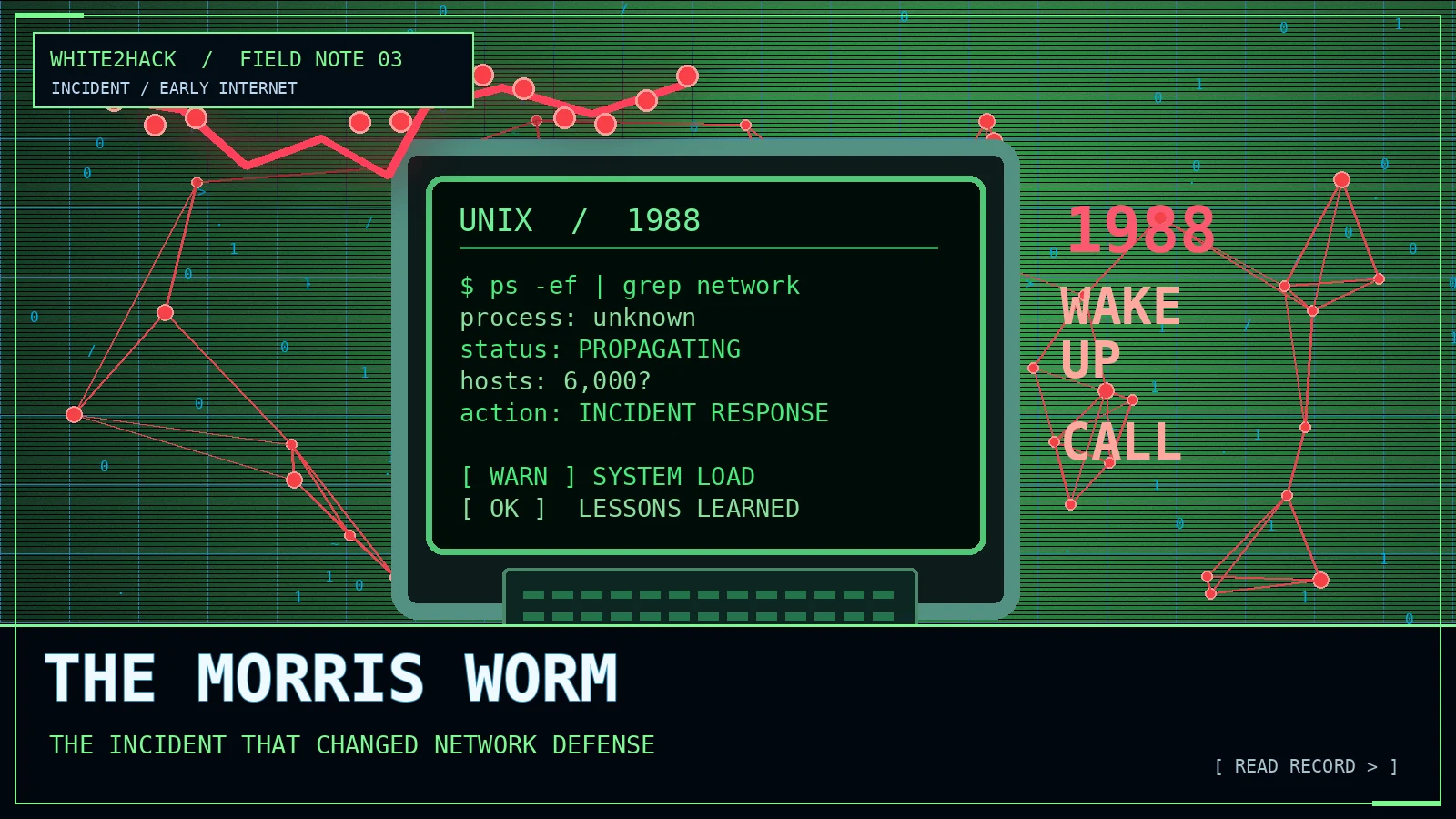
In November 1988, the early Internet faced a shock. A self-propagating program spread across connected computers and overwhelmed many systems. The Morris worm became one of the defining incidents in network security history.
What happened
Robert Tappan Morris, then a graduate student at Cornell, released a program that spread between networked Unix systems. Its behavior included attempts to move from one system to another by abusing weaknesses in services and trust relationships. A flaw in its replication behavior contributed to repeated infections and serious resource exhaustion.
The effects were visible across universities and research organizations that depended on networked systems. The Computer History Museum describes roughly 6,000 affected hosts out of an Internet of about 60,000 hosts at the time; historical estimates vary.
Why its impact was so large
Connected systems can amplify the consequences of local mistakes. A program that works once on a test machine may behave disastrously when it runs simultaneously across many hosts. The worm demonstrated the danger of weak isolation, fragile assumptions and insufficient coordination during a rapidly developing network incident.
From crisis to coordination
Following the worm, coordinated response gained urgency. DARPA helped create the Computer Emergency Response Team (CERT) at Carnegie Mellon University in late 1988, establishing a model for broader collaboration when large-scale incidents occur.
Lessons for today's defenders
- Inventories matter: know what is reachable and what services are exposed.
- Layer defenses and eliminate unnecessary paths between systems.
- Monitor unusual processes, resource spikes and unexpected lateral behavior.
- Rehearse incident communication before an emergency.
- Test in isolated environments with explicit permission.
Scale changes everything. A minor mistake can become a network-wide event when reproduction and connectivity meet.