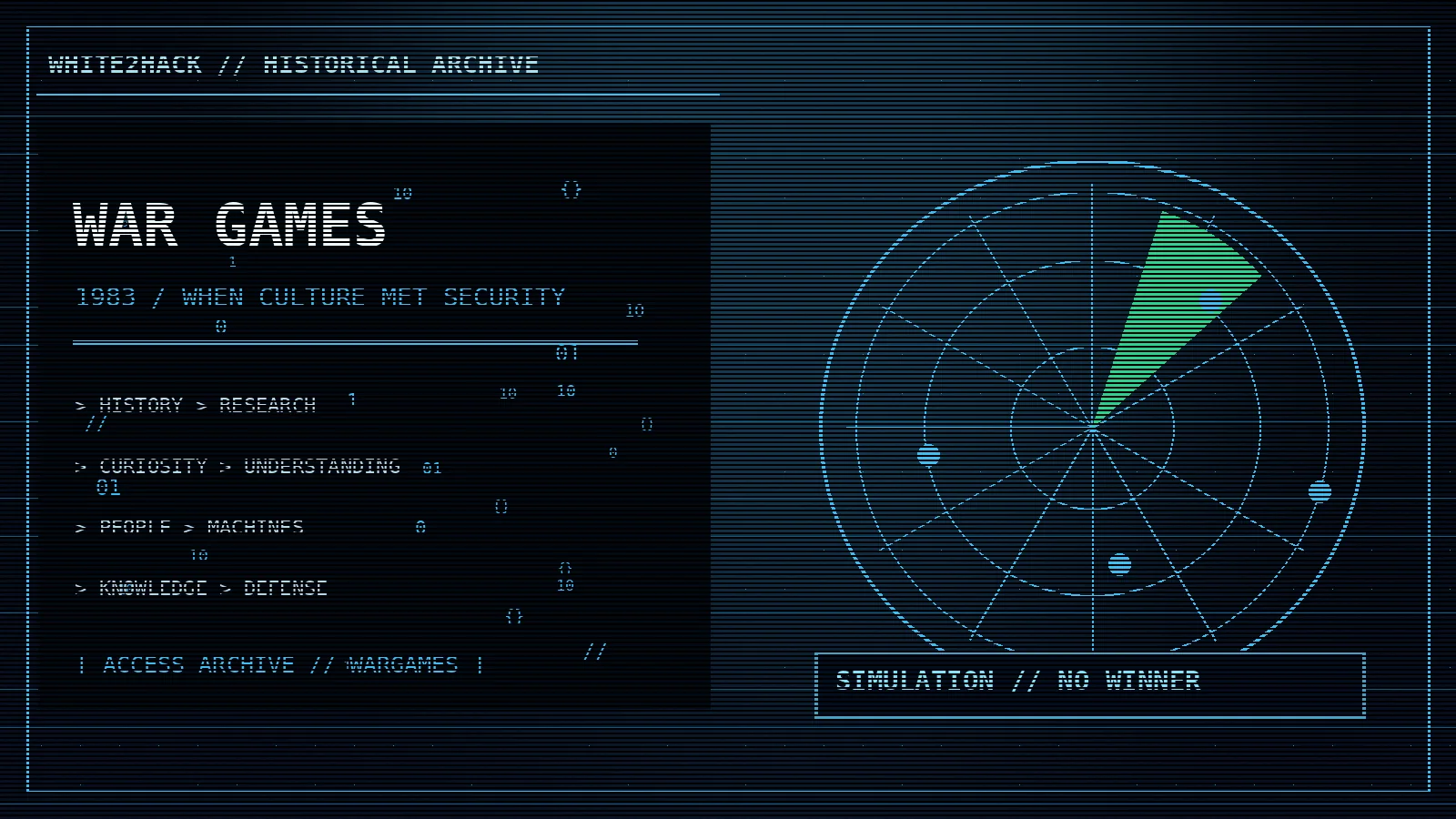
Original editorial illustration.
In 1983, WarGames presented a teenager who accidentally connects to a military computer and almost triggers a catastrophe. Its computers were fictionalized, but its premise captured a genuine anxiety: increasingly networked systems might make unexpected connections with very serious consequences.
A movie about computers — and consequences
Directed by John Badham and starring Matthew Broderick and Ally Sheedy, WarGames follows David Lightman, a technically curious teenager who mistakes access to a military system for a computer game. The fictional WOPR supercomputer becomes a dramatic symbol of overconfidence in automated decisions.
The story was unusually tangible for its time: modems, terminals, phone lines and text interfaces were all visible on screen. People who had never used a computer could suddenly imagine what connecting to a remote machine might mean.
The shape of a generation’s imagination
WarGames strengthened the association between technically gifted teenagers and remote access to powerful systems. For many viewers, the imagery of a blinking cursor, a dark terminal and a ringing modem became a shorthand for hacking.
The film helped spark conversations about unauthorized access, security policy and the consequences of depending on complex systems. Stories about its influence on policymakers are common; the careful historical position is that it contributed to a broader debate already under way.
Where cinema stops and security begins
The film is not an accurate technical guide to modern security or nuclear command systems. It compresses real-world procedures, operations and probabilities to create suspense. That is precisely why it is best enjoyed as historical culture rather than a depiction of a reproducible attack.
But its themes aged surprisingly well: interfaces can mislead users; software operates inside organizational processes; automation can amplify bad assumptions; and people must understand what decisions they are delegating.
A strange kind of hacker movie
At its heart, WarGames is less a celebration of breaking in than a warning about systems without sufficient safeguards. It also captures the spirit of experimentation that made early computing feel like a frontier.
If the screens on White2Hack look like a place where David Lightman might type a command, that is intentional. The lesson to keep is curiosity guided by responsibility.
Sources & Further Reading
Historical references are linked for independent reading. Interpretations and original artwork are editorial.